
It was December 26th. My parents were about to fly back to Sweden after spending Christmas with us in New York. We were sitting in the living room — me, my wife Alicia, my mom, my dad — doing that thing families do on the last day of a visit, where you're together but already half-thinking about the goodbye.
That's when they mentioned, almost casually, that they'd each been writing a book.
Both of them. Separately. My mother was writing about her childhood — all the aunts and uncles in her mother's extended family, the people she grew up around. My dad was working on something about the places he'd lived. They each had about forty or fifty pages.
And they were both stuck. Not stuck as in they couldn't remember — they had plenty to say. Stuck as in they didn't know how to shape what they had into something finished. They had the raw material. What they were missing was a way forward.
I'd been experimenting with something at the time — using AI to ask me questions instead of the other way around. I'd been surprised by how much it pulled out of me, just by asking the right thing at the right time. Sitting there, listening to my parents describe this problem they were both having, the idea landed fully formed.
"What if I built an app that asked you questions?" I said. "Something that could guide you through it?"
They both said that'd be great. The way parents do — encouraging but not expecting much.
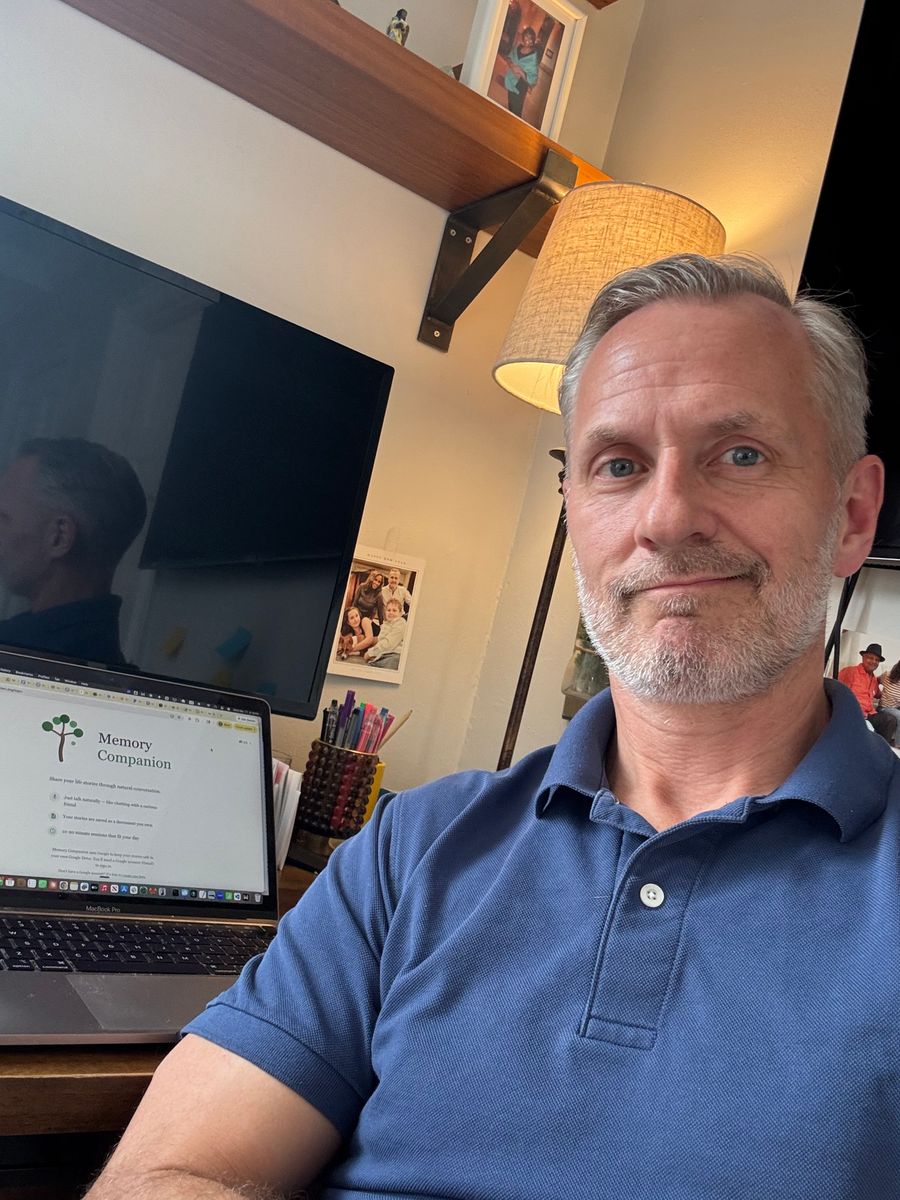
A couple of days later, I sat down and started building. I described what I wanted to an AI tool — an app where you just talk. The AI asks questions, one at a time, and follows wherever you go. No typing. You just speak, and it listens.
A few days later, with the help of my wife Alicia, who's a developer, I had a working app. Rough, but something my mom could actually try.
That first version was fully voiced — you'd speak, and the moment you went silent, the AI would start talking back. I tested it myself and found it stressful. You couldn't pause. You couldn't sit with a thought for a moment before the AI jumped in. For a product meant to help someone reflect on their life, that was exactly wrong.
So I kept adjusting. The basic structure was right, but the details mattered — how long the AI waits, how it phrases a question, when it stays quiet. The kind of things you only learn by using it yourself and watching someone else use it.
My mom was in Sweden. I was in New York. I asked her if she wanted to try it, and she just... clicked through and started. No long explanation. No tutorial. She opened it and began talking.
She's 81. She does about ten minutes a day now — four or five questions, then she's done. It's become part of her routine.
She told me — and told my sister, separately — that sometimes she gets tears in her eyes because the questions make her think so deeply about her childhood. About the people who meant the most to her. The AI asks her things no one has thought to ask, and it takes her back to places she hadn't visited in decades.
That was when I knew it was working. Not because of any metric. Because my mom, unprompted, told two of her children the same thing.
My mom's stories live in her own Google Drive. Not in my database. Not on my servers. Everything she says gets polished into written passages and saved to a document in her account — and she decides who sees it.
I know her document is somewhere around thirty or forty pages at this point. But I don't know what's in it. I don't know which aunts and uncles she's been talking about, or what memories have made her cry. I don't have access, and I don't want it. That's her decision to make, not mine.
It also keeps things simple. I'm not sitting on a database of people's most personal stories. I don't have to worry about protecting what I never had in the first place.
I built Memory Companion because my parents were stuck. It turns out a lot of families have the same problem.
The options have always been limited. You can buy someone a book of questions to fill in — but that means writing, which is the hard part. You can hire a professional to interview them and write a biography — but that costs thousands of dollars and takes months. Most families just never get around to it. Not because they don't care, but because there hasn't been a simple way to do it.
The app is simple. You open it, you talk, you stop when you're done. The conversation becomes a written passage. Over time, the passages become a memoir. The hard part was always just getting it down.
My mother has been doing ten minutes a day since January. She hasn't stopped.
If this sounds like something your family needs, you can find Memory Companion at memorycompanion.org. It's free to try.